Guide
Jet Ski Laws by State: Riding Rules in All 50 States
Published
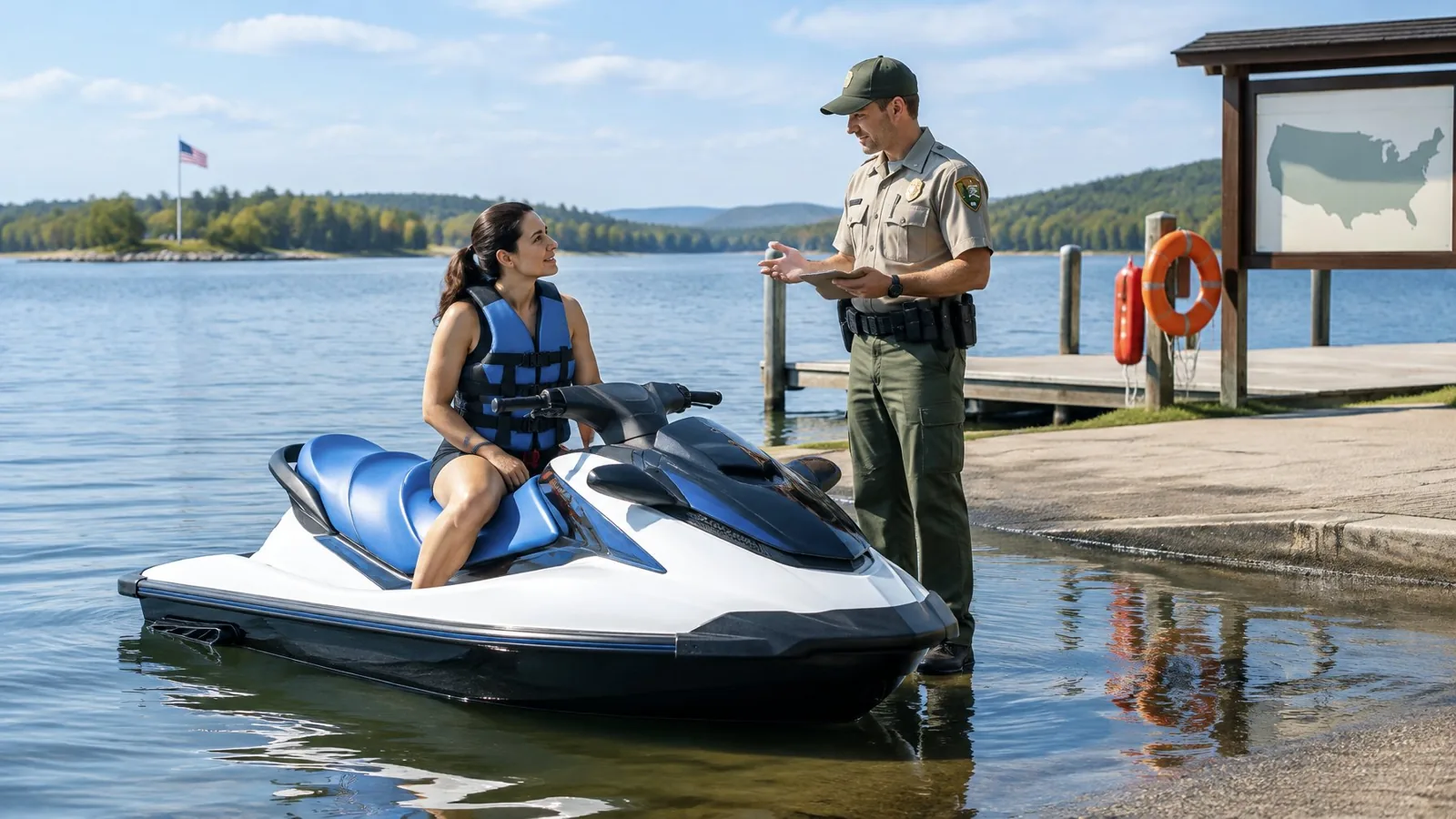
Jet ski laws by state share two core rules: most states require everyone on a PWC to wear a life jacket and limit riding at night. Minnesota allows operation only from 9:30 a.m. to one hour before sunset, while Michigan bars it from sunset to 8 a.m.
Rules for the engine cut-off lanyard, riding near shore, wake jumping, and towing also differ by state. Check the rules for the state and waterway where you plan to ride before launching.
Key Takeaways
- Wear the life jacket required for your PWC and attach its cut-off lanyard when required.
- Check permitted riding hours and local speed or distance limits before you launch.
- Follow your state’s rules for wake jumping and towing.
The Short Answer
Your state sets the rules for riding a jet ski, and those rules cover safety gear, riding hours, distance limits, and towing. A rule that applies on one lake may differ from the rule on another waterway in the same state.
Use the state table below to find a specific rule, then check the linked state page for details about the water where you plan to ride. For operator age or education requirements, see What Age Can You Drive a Jet Ski; for license requirements, see Do You Need a License to Drive a Jet Ski.
Life Jackets on a Jet Ski
Many states require every person on a PWC to wear a USCG-approved life jacket while riding. Some rules also cover people being towed, require the jacket to be secured or snug, or name the types of approved jackets.
Inflatable life jackets are barred for PWC use in several states, including Arkansas, Florida, and Texas. Other states specify non-inflatable or inherently buoyant jackets. Check the state table for the wording that applies where you ride, and follow the jacket label.
Engine Cut-Off Lanyards
If your PWC has an engine cut-off lanyard, your state may require you to attach it to your body, clothing, or life jacket. The switch can stop the engine if you fall off, so connect the lanyard before starting the craft whenever your state requires it.
Rules also differ for wireless cut-off devices and self-circling features. Some requirements apply only when the PWC is underway, on plane, or above displacement speed; use the state-specific wording below.
When Can You Ride?
Many states restrict PWC operation from sunset to sunrise, while some allow night riding when the craft has required navigation lights. Other states set a different time window or limit riding to daylight.
Minnesota’s rule allows operation only from 9:30 a.m. to one hour before sunset. Michigan’s rule bars operation from sunset to 8 a.m. Check the exact hours for your state, including any conditions tied to visibility or navigation lights.
How Close Can You Ride to Shore or Other Boats?
Distance and speed limits vary by state and by the type of nearby water user or structure. A state may require slow, no-wake speed near shore, docks, swimmers, or moored boats, and some rules set a separate distance from moving vessels.
The exact limits range from a set speed within a stated distance to a requirement to keep a certain distance from a skier. Use the state table for the distances and speeds that are specified for your location.
Wake Jumping and Reckless Riding
States restrict wake jumping and other riding that puts people or property at risk. Rules may ban jumping another vessel’s wake within a set distance, weaving through congested traffic, or swerving at the last moment.
Some states also restrict following closely behind a boat towing a skier, blocking another operator’s view, or chasing wildlife. Keep a safe course around other boats and swimmers, and check the state-specific rule before riding.
What Do You Need to Tow a Skier or Tuber?
Your PWC must meet your state’s towing rules before you pull a skier or tuber. Requirements can include a manufacturer-rated passenger capacity, an observer who watches the person being towed, or mirrors that give the operator a clear view.
The details vary: some states accept mirrors, some require an observer, and some require both a suitable passenger rating and an observer. Check the towing entry in the state table before taking a person behind your PWC.
Other Jet Ski Rules
State rules can also limit where you ride and how many people your PWC carries. Some waters prohibit PWC use, while other rules restrict operation in marine reserves, canals, or smaller lakes and ponds.
Your manufacturer’s passenger limit also appears in some state rules. For the location-specific details provided for each state, use the table below.
Which State-Specific Riding Restrictions Should You Check?
Check the entry for your state to find a specific rule for life jackets, lanyards, hours, speed and distance, towing, or restricted waters. The details below use the rule wording for the topic shown; an unmentioned topic still requires a check of the state page.
- Day Sunrise-to-sunset restriction (26 states)
- Time Different time window — read the exact rule (6 states)
- Lit Navigation-light condition — read the exact rule (9 states)
- ? Check the state page (9 states)
Day means sunrise through sunset; Time means a different window, such as a half-hour offset or morning start time. Lit identifies a navigation-light condition; grey means riding hours are not available here. Visibility and local restrictions still apply; expand the table for the exact wording.
Read every state and its rule
| State | Category | Rule or term |
|---|---|---|
| Alabama | Check the state page | Check the state page |
| Alaska | Check the state page | Check the state page |
| Arizona | Navigation-light condition — read the exact rule | No PWC operation between sunset and sunrise or in restricted visibility unless it has proper navigation lights. |
| Arkansas | Different time window — read the exact rule | PWC may be operated only from one-half hour before sunrise to one-half hour after sunset. |
| California | Sunrise-to-sunset restriction | No PWC operation from sunset to sunrise, even with navigation lights. |
| Colorado | Different time window — read the exact rule | No PWC operation from one half hour after sunset to one half hour before sunrise (C.R.S. 33-13-108). |
| Connecticut | Sunrise-to-sunset restriction | No PWC operation from sunset to sunrise. |
| Delaware | Navigation-light condition — read the exact rule | No PWC operation between sunset and sunrise unless the craft has the required navigation lights. |
| Florida | Different time window — read the exact rule | No PWC operation from a half hour after sunset to a half hour before sunrise, even with navigation lights. |
| Georgia | Sunrise-to-sunset restriction | No PWC operation between sunset and sunrise. |
| Hawaii | Check the state page | Check the state page |
| Idaho | Navigation-light condition — read the exact rule | No PWC operation between sunset and sunrise or in restricted visibility unless the PWC has the required navigation lights. |
| Illinois | Sunrise-to-sunset restriction | No PWC operation between sunset and sunrise. |
| Indiana | Navigation-light condition — read the exact rule | PWC may be operated during daylight hours only unless equipped with the required lights. |
| Iowa | Sunrise-to-sunset restriction | No PWC operation between sunset and sunrise. |
| Kansas | Sunrise-to-sunset restriction | PWC may not be operated between sunset and sunrise. |
| Kentucky | Sunrise-to-sunset restriction | PWC may be operated only between sunrise and sunset. |
| Louisiana | Navigation-light condition — read the exact rule | No PWC operation between sunset and sunrise unless it has USCG-compliant navigation lights. |
| Maine | Sunrise-to-sunset restriction | No PWC operation between sunset and sunrise. |
| Maryland | Sunrise-to-sunset restriction | No PWC operation between sunset and sunrise or in limited visibility. |
| Massachusetts | Sunrise-to-sunset restriction | No PWC operation between sunset and sunrise. |
| Michigan | Different time window — read the exact rule | No PWC operation from sunset to 8 a.m. |
| Minnesota | Different time window — read the exact rule | PWC may operate only from 9:30 a.m. to one hour before sunset. |
| Mississippi | Check the state page | Check the state page |
| Missouri | Check the state page | Check the state page |
| Montana | Check the state page | Check the state page |
| Nebraska | Sunrise-to-sunset restriction | No PWC operation from sunset to sunrise. |
| Nevada | Navigation-light condition — read the exact rule | No PWC operation between sunset and sunrise unless equipped with the required navigation lights. |
| New Hampshire | Sunrise-to-sunset restriction | Ski craft may operate only from sunrise to sunset. |
| New Jersey | Sunrise-to-sunset restriction | No PWC operation between sunset and sunrise or in restricted visibility, and none in the Point Pleasant or Cape May canals. |
| New Mexico | Check the state page | Check the state page |
| New York | Sunrise-to-sunset restriction | No PWC operation from sunset to sunrise. |
| North Carolina | Sunrise-to-sunset restriction | No PWC operation between sunset and sunrise. |
| North Dakota | Check the state page | Check the state page |
| Ohio | Sunrise-to-sunset restriction | No PWC operation between sunset and sunrise. |
| Oklahoma | Navigation-light condition — read the exact rule | No PWC operation between sunset and sunrise unless it has the required navigation lights. |
| Oregon | Navigation-light condition — read the exact rule | PWC need the required navigation lights to operate between sunset and sunrise. |
| Pennsylvania | Sunrise-to-sunset restriction | No PWC operation from sunset to sunrise. |
| Rhode Island | Different time window — read the exact rule | No PWC operation from one-half hour after sunset to one-half hour before sunrise. |
| South Carolina | Sunrise-to-sunset restriction | No PWC operation after sunset or before sunrise. |
| South Dakota | Navigation-light condition — read the exact rule | A PWC without navigation lights may not run between sunset and sunrise or in low visibility. |
| Tennessee | Sunrise-to-sunset restriction | PWC may be operated only from sunrise to sunset. |
| Texas | Sunrise-to-sunset restriction | PWC may not be operated at night (sunset until sunrise). |
| Utah | Sunrise-to-sunset restriction | No PWC operation between sunset and sunrise (Utah Code 73-18-15.3). |
| Vermont | Sunrise-to-sunset restriction | PWC may be operated only between sunrise and sunset. |
| Virginia | Sunrise-to-sunset restriction | No PWC operation between sunset and sunrise. |
| Washington | Sunrise-to-sunset restriction | No PWC operation between sunset and sunrise. |
| West Virginia | Sunrise-to-sunset restriction | No PWC operation between sunset and sunrise. |
| Wisconsin | Sunrise-to-sunset restriction | No PWC operation between sunset and sunrise. |
| Wyoming | Check the state page | Check the state page |
| State | State-specific riding detail |
|---|---|
| Alabama | Everyone on board a PWC must wear a properly secured USCG-approved life jacket. A PWC towing a skier must have mirrors on both the left and right sides, at least 2.5 by 4 inches. |
| Alaska | On U.S. navigable waters, operators of boats under 26 feet with an engine cut-off device, which includes most PWC, must use it when on plane or above displacement speed. Anyone under 13 must wear a life jacket on a PWC. |
| Arizona | No PWC operation between sunset and sunrise or in restricted visibility unless it has proper navigation lights. Everyone on board must wear a USCG-approved wearable life jacket, fastened and snug. |
| Arkansas | PWC may be operated only from one-half hour before sunrise to one-half hour after sunset. Stay at slow, no-wake speed within 100 feet of anchored or moored vessels, shoreline, docks, swim areas, swimmers, people fishing and paddlecraft. Inflatable life jackets are not approved for PWC. |
| California | No PWC operation from sunset to sunrise, even with navigation lights. Everyone on board a personal watercraft must wear a USCG-approved life jacket. |
| Colorado | No PWC operation from one half hour after sunset to one half hour before sunrise. Inflatable life jackets are not approved for PWC use. |
| Connecticut | Slow, no-wake speed within 200 feet of shore, docks, swimmers and moored boats. A PWC towing a skier must be rated to carry at least three people. |
| Delaware | Headway speed within 100 feet of docks, piers, shore, swimmers and anchored boats; 300 feet in parts of the Inland Bays near towns and along the ocean. A PWC towing a skier must carry a competent observer facing the person towed. |
| Florida | Everyone operating, riding on or being towed behind a PWC must wear a non-inflatable USCG-approved life jacket. No PWC operation from a half hour after sunset to a half hour before sunrise, even with navigation lights. |
| Georgia | Operate at idle speed within 100 feet of any moored or anchored vessel, dock, pier, bridge, person in the water or shoreline. A PWC towing a skier must be rated for at least three people and carry an observer; a mirror does not substitute. |
| Hawaii | No thrill craft operation in marine life conservation districts or marine natural area reserves, and operation is limited in other designated areas. |
| Idaho | No PWC operation between sunset and sunrise or in restricted visibility unless the PWC has the required navigation lights. PWC must be operated in a reasonable and prudent manner; no weaving through congested traffic. |
| Illinois | Everyone on a PWC or specialty prop-craft must wear a USCG-approved life jacket; inflatable life jackets are not allowed. No PWC operation between sunset and sunrise. |
| Indiana | PWC may be operated during daylight hours only unless equipped with the required lights. Inflatables are not approved for PWC use. |
| Iowa | No more than 5 mph within 100 feet of a vessel going 5 mph or less, or within 50 feet of a vessel going faster. No more than 10 mph within 300 feet of shore on inland lakes and federal impoundments (except specially zoned areas), or unless you can see 200 feet ahead. |
| Kansas | Everyone on a PWC must wear a life jacket at all times, regardless of age. PWC may not be operated between sunset and sunrise. |
| Kentucky | PWC may be operated only between sunrise and sunset. PWC are prohibited on Cedar Creek Lake. |
| Louisiana | No PWC operation between sunset and sunrise unless it has USCG-compliant navigation lights. Do not chase or harass wildlife. |
| Maine | PWC are banned on dozens of named lakes and ponds; check local rules. Everyone on a PWC must wear a USCG-approved life jacket (handbook: non-inflatable). |
| Maryland | Keep to 6 knots or less within 100 feet of any shore, pier, bridge abutment, another PWC or people in the water; on the Atlantic Ocean, stay 300 feet from people in the water and surf fishermen. |
| Massachusetts | Stay at slow, no-wake speed (6 mph or less) within 150 feet of a swimmer, the shoreline, a water skier, a boat launch, a raft or float, or a moored or docked boat. No operation on waters under 75 acres, or while towing people on skis, tubes or similar devices. |
| Michigan | No crossing within 150 feet behind another vessel, or running in water less than 2 feet deep, unless at slow no-wake speed. Inflatable life jackets do not count. |
| Minnesota | Stay at slow no-wake speed (5 mph or less) within 150 feet of shore, docks, swimmers, non-motorized boats and moored or anchored boats. Do not weave through traffic or jump another craft's wake within 150 feet of it. |
| Mississippi | A PWC towing a skier must be rated for at least three people. On marine waters south of I-10, no wake jumping within 100 feet of another vessel, and no following within 100 feet of a water skier. |
| Missouri | No weaving through congested traffic, jumping another boat's wake when visibility is obstructed, or becoming airborne crossing a wake within 100 feet of the other boat. |
| Montana | Keep to no-wake speed within 200 feet of a dock, swimmer, swimming raft, non-motorized boat or anchored vessel. |
| Nebraska | A PWC may tow a person only if it is designed for more than one person and the manufacturer recommends it for towing. No jumping another vessel's wake within 50 yards, and the operator must face forward. |
| Nevada | No PWC operation between sunset and sunrise unless equipped with the required navigation lights. Inflatables are not allowed. |
| New Hampshire | Headway speed only within 150 feet of swimmers, other vessels, rafts, docks, swimming areas or mooring fields. No ski craft operation in coves (1,000 ft wide or less) or within 300 feet of shore except at headway speed heading directly to a permitted area; banned on lakes and ponds under 75 acres. |
| New Jersey | Headway speed only within 100 feet of swim-area markers, the shoreline, people in the water or homes; no jumping wakes within 100 feet of another vessel. No PWC operation in the Point Pleasant or Cape May canals. |
| New Mexico | A PWC may tow a skier only if it has manufacturer seating for at least three people, a vacant seat for the skier and an observer on board besides the operator. A PWC that tows must also display a skier-down flag when the person is in the water. |
| New York | Everyone on a PWC must wear a securely fastened USCG-approved life jacket; most inflatable life jackets are not approved for PWC use. No PWC operation from sunset to sunrise. |
| North Carolina | Stay at no-wake speed within 100 feet of anchored or moored boats, docks, piers, swimmers, anglers or paddle craft (50 feet in a narrow channel). |
| North Dakota | Slow/no-wake speed within 100 feet of shore anglers, swimmers, swim rafts and occupied, anchored or non-motorized boats. A PWC towing someone needs an observer on board or a mirror on each side. |
| Ohio | No PWC operation between sunset and sunrise. Everyone on a personal watercraft must wear a USCG-approved wearable life jacket used according to its label. |
| Oklahoma | Stay at slow, no-wake speed within 150 feet of boat ramps, docks, piers and anchored or moored vessels, and do not operate within 50 feet of a moving vessel. |
| Oregon | Slow-no-wake within 200 feet of swimmers, docks, ramps, marinas and lake shorelines, and within 100 feet of anchored or non-motorized boats; ride no closer than 200 feet behind a towed skier. A PWC may tow only if it is rated for three people and a second person on board continuously watches the person being towed. |
| Pennsylvania | A PWC with a capacity of three or fewer may not tow more than one person on a towed device. Inflatable life jackets are not acceptable. |
| Rhode Island | Headway speed only within 200 feet of swimmers, divers, the shoreline or moored vessels; no unnecessary wake jumping or weaving. |
| South Carolina | Idle speed within 50 feet of a moored or anchored vessel, dock, pier or person in the water, and within 100 yards of the Atlantic coastline; on the major named lakes, idle speed within 100 feet of docks and piers. A PWC towing a skier must have a wide-angle mirror or an observer on board. |
| South Dakota | Slow no-wake speed (5 mph or less) within 150 feet of non-motorized boats, shore, docks, swim rafts, swimmers and moored or anchored boats. Inflatable life jackets are not approved for PWC use. |
| Tennessee | PWC may be operated only from sunrise to sunset. No jumping the wake of another vessel within 100 feet, weaving through traffic, or swerving at the last moment to avoid a collision. |
| Texas | Stay at headway speed within 50 feet of another PWC, boat, platform, person, object or shore. Inflatable life jackets are not approved for PWC use. |
| Utah | No PWC operation between sunset and sunrise. Anyone operating a PWC must wear a life jacket. |
| Vermont | PWC may be operated only between sunrise and sunset. Everyone on a PWC must wear a USCG-approved life jacket. |
| Virginia | Go at slowest possible steerage speed within 50 feet of docks, piers, boathouses, boat ramps, people in the water and other non-PWC vessels. Do not carry more people than the manufacturer's recommended capacity. |
| Washington | No PWC operation between sunset and sunrise. The lanyard of the engine cut-off switch must be attached to the operator, and the switch may not be disabled. |
| West Virginia | A PWC that tows must carry a rear-facing observer at least 12 years old (mirrors do not count), within the maker's passenger limit. Inflatables do not count. |
| Wisconsin | Stay at slow-no-wake speed within 100 feet of any other boat, within 100 feet of a dock, pier, raft or restricted area on a lake, and within 200 feet of shore on any lake. |
| Wyoming | No crossing or jumping another boat's wake within 100 feet of that boat. PWC are banned on certain waters named in the Watercraft Regulation. |
Figures come from each state's official sources as recorded on our state pages. Rules change, so confirm with the official source linked on each state guide before you go.